The mirror had become Elena’s only confidant, though it was a cruel one. At nineteen, she moved through the world like a ghost, a collection of sharp angles and translucent skin. She lived by the cold arithmetic of calories, finding a hollow sense of power in every skipped meal. But the power was an illusion; in reality, she was freezing even in the summer, her hair was thinning, and her thoughts were a gray fog of obsession.
The turning point didn’t come with a grand revelation, but with a collapse. One Tuesday afternoon, the world simply tilted and went black. When she woke up in a hospital bed, the “control” she thought she had was gone. The doctors spoke of heart strain and electrolyte imbalances, but it was the look in her mother’s eyes—a hollow, pleading terror—that finally cracked the shell Elena had built around herself.

The journey back was not a straight line; it was a grueling, uphill battle against a voice in her head that screamed “traitor” every time she took a bite. In the residential treatment center, Elena met the “Refeeding Phase.” It was the hardest part. As her body began to heal, it felt alien. She dealt with the physical discomfort of a restarting metabolism—the bloating, the night sweats, and the way her body desperately held onto weight in her midsection to protect her vital organs.
She cried during supervised meals, her hands shaking as she held a fork. She felt as though she was losing her identity. “If I’m not the thin girl,” she whispered to her therapist, “then who am I?”
The answer came slowly, alongside the nutrients. As her weight moved toward a healthy range, the gray fog in her mind began to lift. For the first time in years, she could follow the plot of a book. She had the energy to laugh at a joke. Her personality, long buried under the demands of her disorder, began to resurface. She discovered she liked painting—not for the “burn” of the activity, but for the joy of the colors.
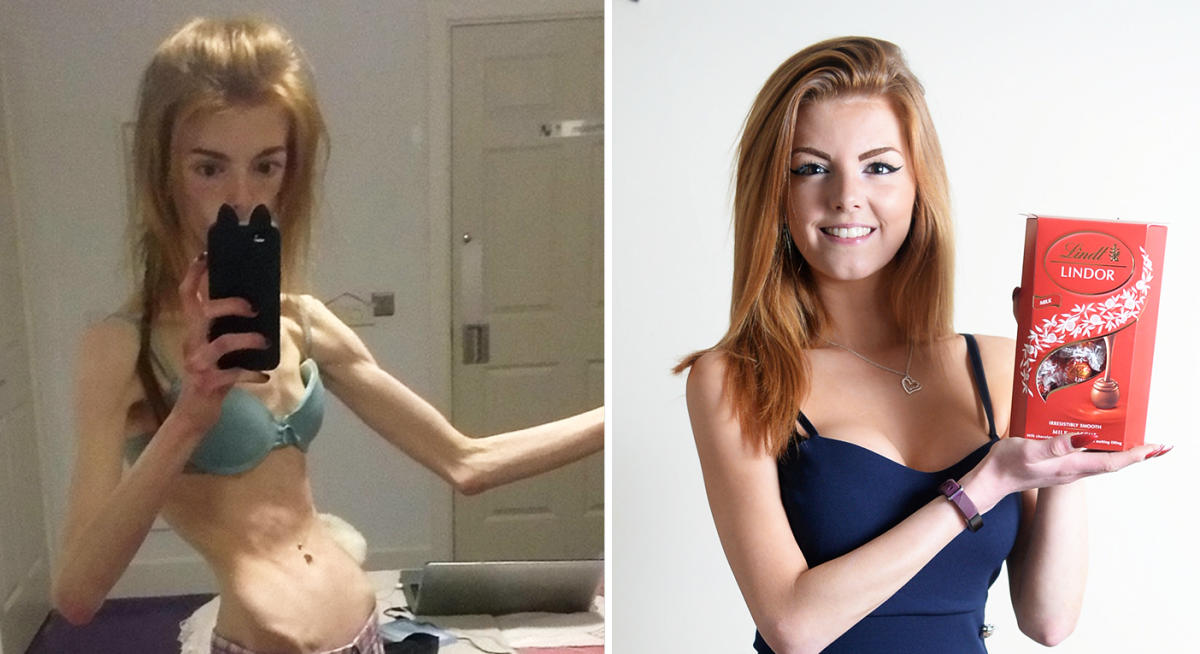
Months later, Elena sat in a sun-drenched cafe with a friend. There was a plate of pasta in front of her. She didn’t look at the nutritional information; she didn’t calculate the miles she would need to walk to “earn” it. She just ate because she was hungry, and because the food tasted of garlic and basil and life.
Her body was softer now, her cheeks held a natural flush, and her clothes fit in a way that didn’t emphasize her bones. She was a “normal weight” by medical standards, but to Elena, she was finally heavy enough to stay grounded in the world. She wasn’t a ghost anymore. She was a woman who was finally, beautifully, taking up space.