Donald Trump has long been recognized for avoiding military service during the Vietnam War, a fact that has remained part of his public narrative for decades. Now, years later, attention has shifted toward his youngest son, Barron Trump, who also appears unlikely to face military service—something that is now stirring frustration and intense debate among segments of the American public.
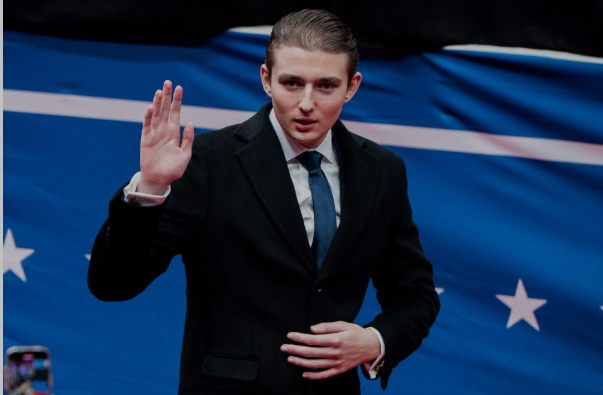
In Barron’s situation, the explanation being cited centers on a medical exemption. However, when viewed within the broader political and global climate, the issue has become far more complicated and emotionally charged than it might initially seem.
Meanwhile, international tensions—especially in the Middle East—have been escalating rapidly. The situation involving Iran has grown increasingly volatile, with reports suggesting that U.S. and Israeli forces have conducted coordinated strikes on multiple key targets, including critical infrastructure inside Tehran.
These developments have fueled widespread speculation, including unverified claims that surfaced over the weekend suggesting Iran’s supreme leader, Ali Khamenei, may have been killed during the attacks.
In retaliation, Iran is said to have launched a series of counterstrikes. By Tuesday, reports indicated that at least six American service members had been killed, while the number of Iranian casualties remains unclear, with conflicting accounts and incomplete information continuing to circulate.
As Donald Trump and his administration reportedly moved ahead with military actions against Iran—allegedly without formal approval from Congress—criticism has grown louder. Opponents are raising concerns not only about the legality of these decisions but also about Trump’s judgment, particularly given his lack of personal military experience.
Notably, none of Trump’s children—Donald Jr., Eric, Ivanka, or Tiffany—have served in the armed forces. This has placed Barron in the spotlight as the only member of the family who might have potentially taken on such a role, further intensifying scrutiny surrounding his exemption.
Trump’s own avoidance of the Vietnam draft has been a subject of controversy for years. According to earlier reports, a podiatrist from Queens, Dr. Larry Braunstein—who passed away roughly two decades ago—diagnosed Trump with bone spurs. Some have suggested that this diagnosis may have been issued as a favor to Trump’s father, Fred Trump, ultimately allowing him to receive a medical deferment.
In a 2016 interview, Trump explained that a physician had provided him with a “very strong letter” detailing problems with his heels, which he submitted to draft authorities. However, he also stated that he could not remember the doctor’s name, which raised further questions.
#SendBarron Hashtag Gains Momentum Amid Iran Conflict
Because of the ongoing doubts surrounding how Donald Trump avoided military service, frustration has been building among many Americans—particularly veterans and those closely connected to the military.
Over the weekend, as tensions with Iran intensified, the hashtag #SendBarron began trending widely on social media, quickly becoming a symbol of public anger and political commentary.
One user wrote, “Why not demonstrate the Trump family’s sense of patriotism by sending Barron to fight in Iran?”
Another commenter added, “At least one member of the Trump family should step forward and serve, instead of benefiting from the sacrifices made by others.”
A different post stated, “#SendBarron. It would be a powerful symbol of unity with our troops and a genuine show of appreciation for what they endure every single day.”
Yet another user remarked, “If you choose leaders who are eager to go to war, then perhaps you—or your own children—should first explain why that war is worth fighting.”
Trump’s perceived distance from the realities of war has also been criticized. One post pointed out, “The President is relaxing at his private club while pushing us toward what feels like World War III. #SendBarron.”
Why Medical Factors May Prevent Barron Trump From Serving
Under standard draft rules, individuals who turn 20 during a given year may fall within the pool of those eligible for service. Barron Trump, who reaches that age in May, would typically meet that criterion. However, in his case, the exemption appears to be based on legitimate physical and medical factors rather than controversial circumstances.
One key consideration is Barron’s height. At approximately 6 feet 7 inches (around 200 cm), he is significantly taller than average, which can present challenges in certain military roles. Positions that involve tight or confined environments—such as tanks, armored vehicles, or aircraft—often have strict physical requirements to ensure both safety and operational effectiveness.
Reports, including those cited by the Mirror, indicate that the U.S. Army imposes height limits for specific roles, generally setting an upper threshold around 6 feet 8 inches. Although Barron technically falls within that range, his height could still create practical limitations, potentially restricting the types of roles he could perform.
Taken together, these physical considerations and medical factors help explain why Barron Trump is unlikely to be called into military service, even in scenarios where others his age might be required to serve.
What are your thoughts on this situation? Do you think the criticism is justified, or has it been blown out of proportion? Share your opinion and join the discussion in the comments on Facebook.